Choosing root canal treatment involves more than comparing a quoted price. You need to know what “advanced” includes, whether the tooth is restorable, what restoration follows, and when swelling or pain signals an urgent problem. By the end, you will have a practical way to compare treatment options, costs, and clinics in Pune.
Key takeaways
- Ask which tools are included: rubber dam, apex locator, rotary files, and magnification.
- Request a written estimate covering imaging, treatment, restoration, and follow-up visits.
- Compare saving the tooth with an implant, bridge, or denture—not price alone.
- Seek urgent review for facial swelling, fever, worsening pain, or difficulty swallowing.
What Makes Root Canal Treatment Advanced, and When Should You Seek Assessment?
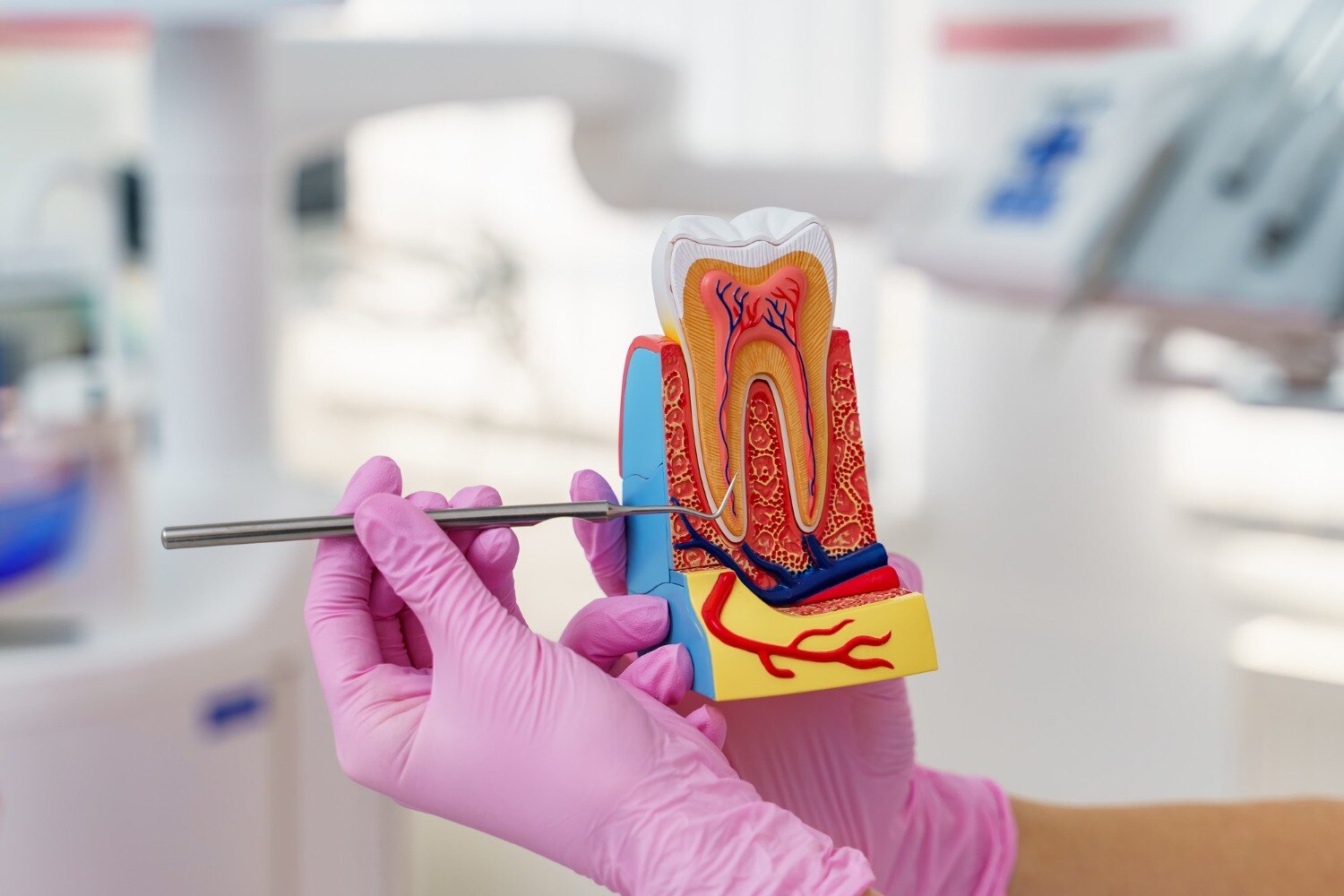
Advanced root canal treatment is not a separate, universally defined procedure. It usually means conventional treatment supported by specific tools: rotary or reciprocating nickel-titanium files, an electronic apex locator, rubber dam isolation, magnification or a dental operating microscope, selective CBCT imaging, and sometimes single-visit treatment.
Ask what is included rather than accepting “advanced” as proof of quality.
Seek prompt assessment for:
- Hot or cold sensitivity that continues after the stimulus is removed
- Spontaneous toothache, pain on biting, facial swelling, a gum boil, fever, or a darkened tooth
For advance root canal treatment in Pune, diagnosis must identify the pain source before treatment begins. During infected tooth treatment in Pune, a dentist uses examination, vitality testing, percussion, periodontal probing, bite tests, dental X-rays, and CBCT when anatomy or diagnosis remains unclear.
| Possible source | Clues | How it is checked |
|---|---|---|
| Pulp infection | Lingering sensitivity or spontaneous pain | Vitality tests, percussion, X-ray |
| Cracked tooth | Sharp pain on biting or release | Bite test, magnification, probing |
| Gum abscess | Local gum swelling or pus | Periodontal probing and examination |
| Exposed dentine | Brief response to cold | Examination and vitality testing |
| Sinus-related pain | Several upper teeth feel painful | Sinus history, tooth tests, imaging |
| Referred jaw pain | Normal tooth responses | Jaw examination and exclusion testing |
A microscope improves visibility but cannot repair a vertical root fracture or make an unrestorable tooth treatable.
What Happens During Diagnosis, Root Canal Treatment, and Final Restoration?
Diagnosis starts with a clinical examination, not a scan. The dentist checks symptoms, tooth response, biting tenderness, gum condition, cracks, and surrounding teeth, then uses dental X-rays to assess roots and bone. CBCT is reserved for complex anatomy, missed canals, resorption, retreatment, or persistent disease because it adds radiation and metal restorations can create artefacts.
1. The tooth is numbed with local anaesthesia and isolated with a rubber dam. Effective anaesthesia should prevent treatment pain; the dam keeps saliva and bacteria away.
2. The dentist makes an access opening through the crown to locate the pulp chamber and canal openings. A dental operating microscope can reveal calcified canals, tiny orifices, cracks, or separated instruments, but it cannot repair a fracture or make an unrestorable tooth treatable.
3. Canal length is measured with an electronic apex locator, supported by radiographs when needed. Rotary or reciprocating nickel-titanium files shape the canals, while irrigating solutions flush out tissue and microbes.
4. The cleaned canals are filled with an inert material, usually gutta-percha, and the access is closed with a temporary seal when definitive restoration is scheduled later.
Tenderness for a few days can follow instrumentation, but treatment pain is not expected with adequate anaesthesia. The temporary seal is not the finish: a definitive filling, onlay, or crown is needed, particularly for molars and premolars. Without adequate coverage, weakened tooth walls can fracture during chewing.
Ask what each stage includes when comparing advanced root canal treatment in Pune.
Should You Save the Tooth or Choose an Implant, Bridge, or Denture?
For anyone comparing advance root canal treatment for benefits cost in Pune, the sound choice depends on whether the tooth can survive restoration, not on preservation alone.
Check for adequate remaining tooth structure and a 1.5–2 mm ferrule, healthy bone and gum support, no severe vertical root fracture, and the ability to isolate, clean, seal, and restore every canal.
Extraction is more predictable when:
- The crown is unrestorable, too little tooth remains for a ferrule, or the tooth cannot be isolated and restored.
- A severe vertical root fracture extends below the gum or into the root.
- Bone or periodontal support is inadequate, with uncontrolled mobility or disease.
| Option | Stages and healing | Long-term effort |
|---|---|---|
| Root canal and restoration | Clean, seal, then place a definitive filling, onlay, or crown; no extraction socket healing | Preserves the tooth, but requires hygiene, reviews, and fracture protection |
| Implant | Extraction, socket healing, implant placement, bone integration, then crown | Does not move neighbouring teeth, but involves surgery, healing, and implant maintenance |
| Bridge | Remove or prepare supporting teeth, fit the bridge after healing | Replaces the gap sooner, but affects adjacent teeth and needs careful cleaning underneath |
| Removable partial denture | Impressions, fitting, adjustments, and extraction-site healing | Removable maintenance; neighbouring teeth can drift if the gap is left untreated |
A root canal can fail from missed canals, inadequate cleaning or filling, leakage, new decay, periodontal disease, or fracture. Retreatment, apical surgery, restoration replacement, or extraction depends on the cause; a microscope cannot repair a vertical fracture.
What Does Root Canal Treatment Cost in Pune, and How Can You Compare Clinics?
Budget roughly, not as a citywide tariff: the root canal cost in Pune may fall within these ranges.
| Tooth or case | Indicative budgeting range | Main reason for variation |
|---|---|---|
| Front tooth | ₹3,000–₹8,000 | Usually fewer, straighter canals |
| Premolar or molar | ₹5,000–₹12,000 | Multiple or curved canals |
| Retreatment or highly complex case | ₹8,000–₹20,000 or more | Previous filling, missed canals, or difficult anatomy |
A crown, core buildup, CBCT scan, sedation, or emergency drainage may be charged separately. The number and curvature of canals, first treatment versus retreatment, microscope or CBCT use, the final restoration, and whether an endodontist performs the procedure can change the quote. A low fee that excludes the crown is not a low treatment cost.
Ask any root canal clinic in Pune for a written plan containing:
- Tooth number and diagnosis
- Number of visits and the isolation method, including rubber dam use
- Dental X-ray or CBCT indication
- Rotary or reciprocating instrumentation and electronic apex locator use
- Temporary seal and recommended final filling, buildup, onlay, or crown
- Review or warranty policy
- Every included and excluded charge
When comparing Dr Hiremaths Dental And Physiotherapy clinic with other clinics, give each provider this same checklist and compare the documented scope, not only the headline price. A written plan also shows whether “advanced” means specific equipment or merely a marketing label.
Related service
Dental Treatment A root canal treatment is a dental procedure designed to save a tooth that's severely damaged or infected. View service → |
What Recovery Is Normal, and Which Symptoms Need Urgent Review?
A few days of mild tenderness after root canal treatment is normal, especially when the tooth was inflamed before instrumentation. The discomfort should gradually ease, not intensify.
Do not chew on the treated tooth until the final filling, onlay, or crown is secure. Take extra care when only a temporary seal is present because the tooth can fracture or the seal can break.
| Symptom | What it suggests | What to do |
|---|---|---|
| Mild tenderness for a few days | Normal post-treatment inflammation | Follow the prescribed pain-relief plan and monitor improvement |
| Increasing pain, persistent or returning swelling | Ongoing infection or another treatment problem | Arrange urgent dental review |
| Fever, malaise, or facial swelling | Infection may be spreading | Seek urgent dental or medical assessment |
| Swelling spreading toward the eye or neck, difficulty swallowing, or difficulty breathing | Potentially serious spreading infection | Obtain emergency medical care immediately |
Pain disappearing does not prove the infection has resolved if swelling remains or returns. An abscess that drains and feels better still needs treatment of its source inside the tooth.
For infected tooth treatment in Pune, do not rely on leftover antibiotics or delay because symptoms temporarily improve. Antibiotics do not replace drainage, root canal treatment, or extraction in most localised infections; a clinician decides their use when fever, malaise, cellulitis, or significant swelling is present. Arrange review promptly rather than self-treating.
Frequently asked questions
What makes root canal treatment advanced?
Advanced treatment uses tools such as rotary or reciprocating nickel-titanium files, an electronic apex locator, rubber dam isolation, magnification or a dental operating microscope, selective CBCT imaging, and sometimes single-visit treatment.
What happens during root canal treatment and final restoration?
The dentist assesses the tooth, removes infected or inflamed pulp, cleans and shapes the canals, seals them, and restores the tooth with a filling or crown when needed.
Should I save the tooth or choose an implant, bridge, or denture?
The choice depends on the tooth’s remaining structure, infection, bone and gum health, restorability, treatment time, maintenance, and total cost. A dentist must assess whether the tooth can be predictably restored.
What does root canal treatment cost in Pune?
The total cost depends on the tooth, number of canals, complexity, imaging, retreatment needs, and final restoration. Ask clinics for an itemised estimate rather than comparing only the root canal fee.
What recovery is normal after root canal treatment?
Mild tenderness after treatment is common and should improve. Contact the clinic urgently for facial swelling, fever, worsening pain, difficulty swallowing, or difficulty breathing.
Keywords