Hip pain can make walking, turning, standing, and recovering from a stumble less secure, but the right exercise depends on the cause and severity of the problem. By the end, you will know when balance and gait work is appropriate, which warning signs require medical assessment, what a session involves, and when strengthening, a walking aid, aquatic exercise, or another treatment is the better first step.
Key takeaways
- Get medical triage before starting balance or gait exercises.
- Choose exercises after checking pain, strength, balance, and walking mechanics.
- Use walking aids or aquatic exercise when land-based training increases pain.
- Track walking confidence, steadiness, pain, and daily function—not pain alone.
When Hip Pain Makes Balance and Gait Training a Good Fit
Usually, yes—but only after medical triage and an individual assessment. Balance and gait training for older adults with hip pain in Pune should not begin as a generic walking programme because hip pain is a symptom, not a diagnosis.
Hip osteoarthritis can shorten steps and make turning painful. Greater-trochanteric pain syndrome, sometimes called bursitis, can make side-lying and single-leg loading difficult. Muscle weakness reduces push-off and pelvic control, while restricted hip movement can cause limping. Fracture recovery requires surgical and weight-bearing guidance.
Referred lumbar-spine pain can cause leg weakness, altered sensation, or an unsteady foot without the hip being the main source.
Wait for medical assessment before exercise if you have:
- A recent fall with inability to bear weight
- Sudden severe pain
- A shortened or visibly rotated leg
- Fever with a hot or swollen joint
- New leg weakness
- Rapidly worsening symptoms
These signs can indicate fracture, infection, nerve involvement, or another urgent problem. Balance training for seniors also needs closer supervision when marked weakness, numbness, dizziness, repeated falls, cognitive impairment, or severe fear of falling is present.
The right plan may combine strengthening, balance tasks, gait retraining, and a walking aid. A physiotherapist should first identify the cause and your specific walking limitation.
What a Physiotherapist Checks Before Choosing Exercises
Before choosing exercises, a physiotherapist checks whether pain and fall risk make each task safe. They locate the pain, assess its irritability, and test movements that aggravate it. They observe walking speed, step symmetry, limping, foot placement, turning, transfers, stair ability, and sit-to-stand performance.
Hip range of motion and leg strength, especially the hip abductors and extensors, reveal restrictions or weakness. Balance recovery after a small loss of stability and safe cane or walker use also matter.
- Review fall history, footwear, vision, sensation, dizziness, medication effects, and home hazards; each factor can change fall risk and supervision needs.
| Choice | Main purpose | What the assessment decides |
|---|---|---|
| Balance training | Recover stability after a sway or trip | Whether you can practise balance safely |
| Gait retraining | Improve steps, turning, and obstacle clearance | Whether walking problems arise from pain, weakness, or poor coordination |
| Hip strengthening | Build force in weak abductors and extensors | Which muscles can be loaded safely |
| Ordinary walking | Increase general activity | Whether straight walking is enough for your actual difficulty |
| Cane or walker instruction | Add immediate support | Whether the device is fitted and used safely |
These options are not interchangeable. When comparing hip pain physiotherapy in Pune, ask whether the evaluation covers this full picture rather than only massage or electrotherapy. After fracture surgery, the surgeon must set weight-bearing limits and hip precautions; exercises cannot override them.
What Happens During Training, and How Pain Changes the Plan
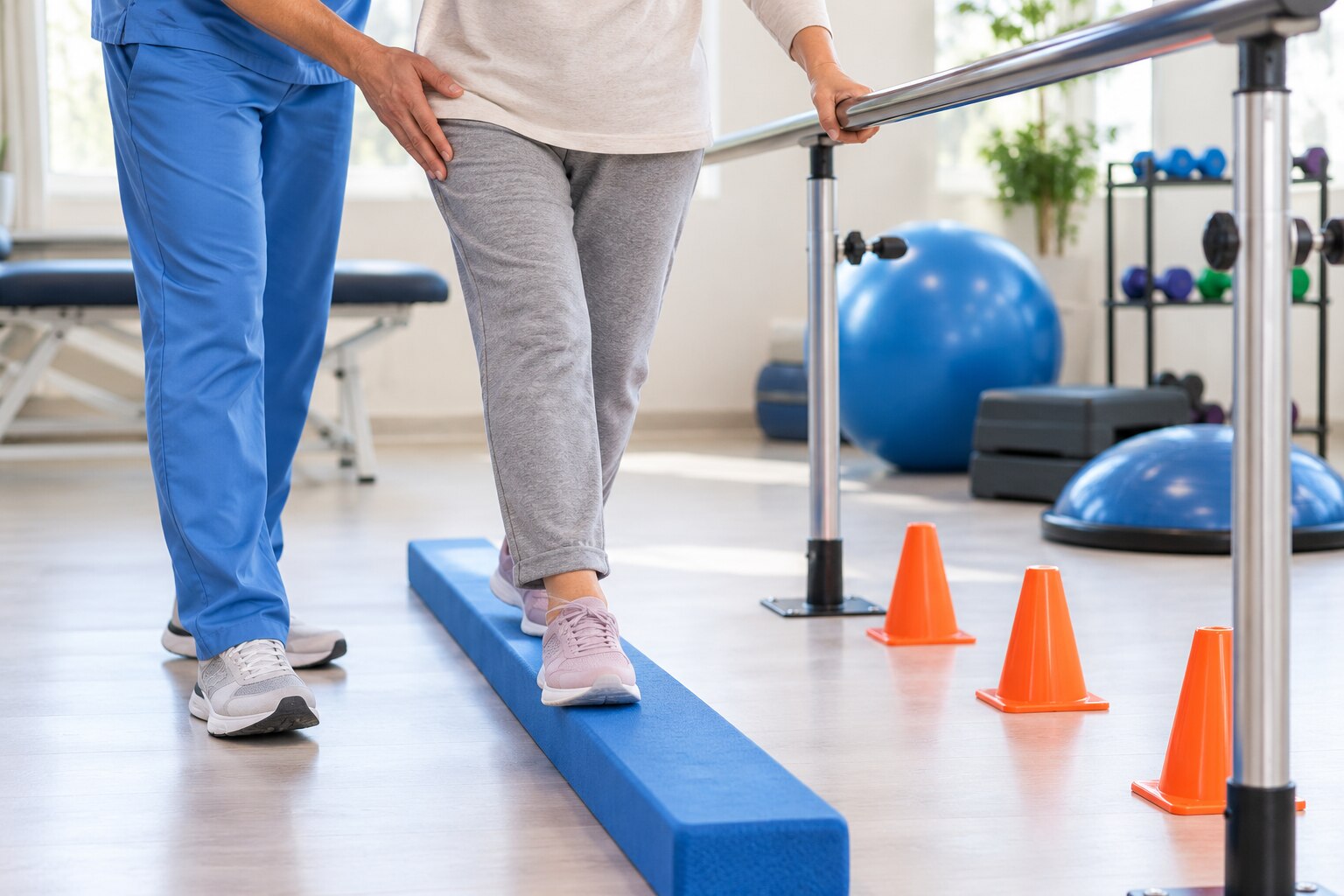
A session starts by observing level-ground walking: speed, step symmetry, limp, foot placement, turning, and cane or walker use. You may practise weight shifts, direction changes, sit-to-stand drills, functional transfers, and stepping over low obstacles.
The therapist moves you from a stable support, such as a countertop or rail, to less-supported tasks only when control is adequate.
- Strengthen the hip abductors and extensors with exercises matched to your ability.
- Rehearse turning, chair transfers, and safe recovery after a small loss of balance.
- Repeat tasks at a slower speed or with fewer repetitions before adding challenge.
- Treat gait training in Pune as task practice, not simply longer walks.
Walking farther improves endurance, but it does not train turning, obstacle clearance, transfers, or balance recovery. The exercise plan must target the task that causes difficulty.
If hip pain rises, reduce the movement range, repetitions, speed, or load. Do not push through sharp or escalating pain. Early osteoarthritis exercise can cause temporary pain or stiffness without proving joint damage, but marked or sustained deterioration requires review of the exercise dose, technique, diagnosis, or treatment.
Tell the therapist whether symptoms settle between sessions or remain worse into the next day. A change in support, exercise selection, or walking aid may restore a safe training level.
Which Option Fits: Strengthening, Aquatic Exercise, Walking Aids, or Home Changes?
The right choice depends on the clinical finding: balance and gait work addresses unsafe movement, while other options target pain, weakness, loading, or environmental hazards.
| Option | Best fit | What to compare |
|---|---|---|
| Supervised hip strengthening | Weakness or osteoarthritis | Builds hip-abductor and extensor capacity; does not replace gait practice when turning or transfers are unsafe |
| Aquatic exercise | Land-based loading is painful | Warm-water buoyancy reduces joint loading; you still need land practice for everyday walking |
| Cane or walker | Immediate support is needed | Reduces load and fall risk while strength or confidence improves; it does not treat the underlying diagnosis |
| Occupational-therapy changes | Hazards increase falls risk | Better lighting, handrails, and removing loose rugs can prevent falls at home |
| Medical treatment | Arthritis, infection, fracture, or another diagnosis drives symptoms | Treat the cause before exercise; infection, fracture, and rapidly worsening pain need medical review |
Hold a cane in the hand opposite the painful or weaker hip, and advance it with the affected leg. A clinician must fit cane and walker height; poor sizing can create stooped posture, unsafe turning, or a new fall risk. A device that reduces pain still needs adjustment if walking becomes awkward.
For walking rehabilitation in Pune or hip pain physiotherapy in Pune, Dr Hiremaths Dental And Physiotherapy clinic is one provider you could ask about assessment-led planning, a falls-risk review, and device instruction. The chosen option must follow clinical findings, not the label of the exercise programme.
Related service
Physiotherapy Improve your balance, mobility, and confidence with our Balance and Gait Training program. View service → |
How to Start Safely and Judge Whether It Is Working
Start with short, repeatable bouts: a few minutes of walking, simple hip and leg strengthening, and brief balance practice. Split these across the day instead of completing one long walk, then progress when pain settles, steadiness improves, and you recover between sessions.
| Activity | Safe starting approach | Progress when |
|---|---|---|
| Walking | Short, comfortable bouts with a cane or walker if assessed | Steps become more even and support is less necessary |
| Strengthening | Low-load sit-to-stand and hip exercises with controlled repetitions | Movement causes no sharp pain or next-day flare |
| Balance | Weight shifts, supported turns, and narrow-stance practice near a stable surface | You recover from small wobbles safely |
The 150-minute weekly moderate-activity target is a longer-term public-health goal, not a starting prescription after acute pain or surgery. After hip-fracture surgery, mobilise daily when medically and surgically permitted, while following the surgeon’s weight-bearing instructions; gait practice cannot override them.
Track progress through practical changes:
- Sit-to-stand feels easier.
- Turns feel safer and require fewer steps.
- Foot placement and step timing become more consistent.
- You rely less on furniture, a cane, or a walker.
- Symptoms do not flare the following day.
Balance and gait training for older adults with hip pain in Pune should follow these responses, not a fixed timetable. Walking rehabilitation in Pune is the safer choice when a clinician can adjust exercises, loading, and equipment to your recovery.
Choose supervised balance and gait training after assessment when walking confidence or task-specific stability is limited; seek medical review first when red flags or unexplained deterioration are present.
Frequently asked questions
When is balance and gait training suitable for an older adult with hip pain?
It suits older adults after medical triage identifies a safe cause and a physiotherapist confirms that supervised movement is appropriate.
What does a physiotherapist check before choosing exercises?
They assess pain behaviour, hip movement, leg strength, balance, walking pattern, transfers, footwear, falls risk, and the need for an aid.
How does hip pain change balance and gait training?
Pain can require shorter sessions, slower walking, reduced loading, more support, or aquatic exercise while strength and tolerance improve.
When should you consider strengthening, aquatic exercise, a walking aid, or home changes?
Choose based on the main limitation: weakness needs strengthening, painful loading may suit water exercise, instability may need an aid, and hazards require home changes.
How can you tell whether walking rehabilitation is working?
Track steadiness, walking distance, transfers, confidence, daily activities, and pain response during and after sessions.
Keywords