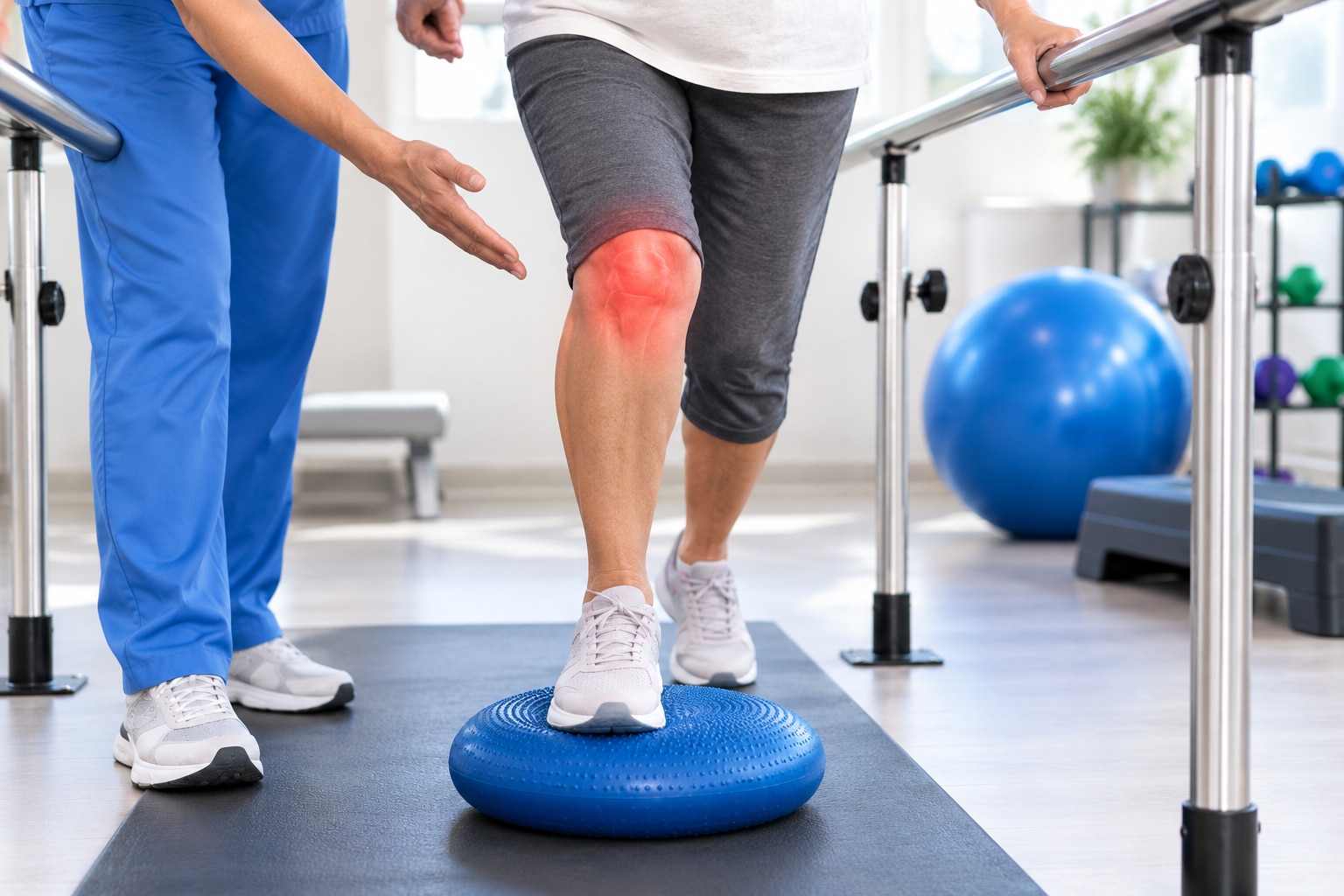
Knee pain does not automatically mean you need walking drills or balance exercises. The value depends on whether your pain comes with limping, buckling, poor weight transfer, fear of stairs, weakness, or reduced control—and whether training is added to the right strengthening and mobility plan.
Key takeaways
- It helps when limping, buckling, poor weight transfer, or weak single-leg control drive symptoms.
- It cannot repair torn ligaments, damaged cartilage, or a meniscus injury.
- A useful programme combines walking drills, balance work, strength exercises, and gradual progression.
- Stop and seek assessment for sudden swelling, locking, severe pain, or repeated falls.
When Balance and Gait Training Adds Value for Knee Pain
Balance and gait training does not help every type of knee pain, and it does not repair damaged cartilage, a torn ligament, or a meniscus injury. It adds value when pain is linked to poor weight transfer, limping, knee buckling, reduced single-leg control, fear of stairs, or altered walking mechanics.
It can support recovery for:
- Osteoarthritis, especially when walking feels unstable or painful on one side
- Patellofemoral pain with poor hip, knee, or foot control
- Ligament or meniscus injuries after medical assessment and appropriate healing
- Post-operative weakness when your surgeon or physiotherapist permits loading
- Weakness that causes uneven steps or compensatory movement
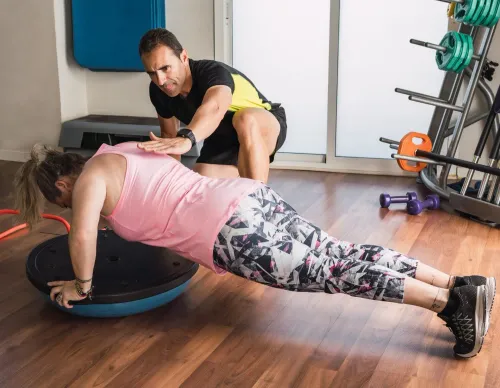
A person whose only problem is pain may gain more immediate benefit from progressive quadriceps, hip, and aerobic exercise than from balance drills alone. Gait retraining can reduce knee loading, but a better-looking posture does not guarantee less pain; judge it by walking comfort, stair ability, and daily function.
Look for a plan with a clear diagnosis, measurable goals, home exercises, and a review date. Useful measures include pain while walking, the Timed Up and Go, 30-second chair-stand, six-minute walk, stair performance, and KOOS or WOMAC scores.
Weight reduction can improve osteoarthritis symptoms when you are overweight; combine dietary support with exercise rather than treating gait work as weight management.
Do not start generic training for a locked knee, major trauma, hot swollen joint, fever, suspected fracture, or rapidly worsening inability to bear weight. Search terms such as balance and gait training for knee pain in Pune or knee pain rehabilitation in Pune cannot establish suitability; assessment does.
Signs That Your Walking Control Is Part of the Problem
A knee that gives way, catches your attention on stairs, or forces you to limp points to a walking-control problem, not pain alone. Assessment is worthwhile when you cannot stand steadily on one leg, turn without several small steps, or walk without watching every foot placement.
| Sign | What it may indicate | What to assess |
|---|---|---|
| Knee buckling | Weakness, poor weight transfer, or reduced confidence | Quadriceps strength and controlled loading |
| Uneven or shortened steps | Guarding, limited movement, or an established limp | Walking speed, stride symmetry, and knee range |
| Wobbling on one leg | Reduced proprioception or hip and knee control | Single-leg stance, only when safe |
| Fear on stairs or uneven ground | Loss of confidence after injury or repeated instability | Step-down control and falls risk |
| Difficulty turning or stopping | Delayed balance reactions | Direction changes and braking control |
| Railing dependence | Insufficient strength, balance, or trust in the knee | Stair mechanics and functional strength |
These signs strengthen the case for targeted gait training for knee pain in Pune or walking training in Pune, but the label does not prove that it is the right treatment. A physiotherapist should also check footwear, neurological status, joint range, pain behaviour, strength, and any history of falls.
If pain is your only limitation, progressive quadriceps, hip, and aerobic exercise may offer more immediate value than balance drills alone.
Do not start a generic programme after major trauma, with a locked knee, a hot swollen joint, fever, suspected fracture, or rapidly worsening inability to bear weight. Seek medical assessment first.
What a Useful Programme Looks Like in Practice
A useful session starts with observation, not a balance pad. The physiotherapist watches your walking, step length, turning, stair use, footwear, limp, and weight transfer, then checks knee movement, leg strength, and single-leg or tandem stance when safe. Your fall history and confidence matter too.
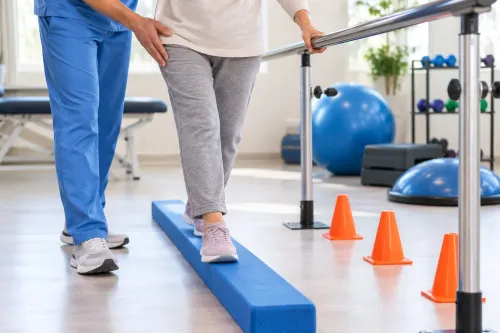
Balance physiotherapy in Pune should translate into tasks you use outside the clinic: controlled sit-to-stands, stepping over obstacles, changing direction, reaching while standing, and walking at different speeds or on suitable surfaces.
Gait training for knee pain in Pune may include a graded walking dose, cadence or step-width changes, and practice with stairs or uneven ground. The clinician should record pain during walking, recovery after exercise, and measures such as the Timed Up and Go, 30-second chair stand, six-minute walk, stair performance, KOOS, or WOMAC.
Balance and gait work is not a replacement for strengthening. It targets control, confidence, and efficient weight transfer; strengthening builds the force needed to support the knee.
| Approach | Main target | What you do |
|---|---|---|
| Balance and gait training | Control during movement | Step, turn, walk, and recover from small challenges |
| Ordinary knee strengthening | Muscle capacity | Perform squats, bridges, leg presses, or knee extensions with prescribed resistance |
| Combined programme | Capacity plus real-world function | Strengthen, then use that strength during walking, stairs, and balance tasks |
A home programme and a review date are essential. The plan should change if walking remains painful, symptoms worsen, or the exercises do not improve a measured task.
How to Judge Progress, Safety, and Suitability
A good fit is shown by better walking comfort and control, not by posture alone. Gait retraining can reduce knee loading, especially with medial knee osteoarthritis, but a laboratory change does not prove less pain or slower joint damage.
Balance work deserves priority when you have buckling, poor single-leg control, reduced position sense, falls, or fear of stairs.
1. Confirm the cause and starting risks. Ask for assessment of strength, joint range, neurological status, footwear, walking mechanics, and fall history. Balance drills alone are a weak choice when pain is your only symptom; progressive quadriceps, hip, and aerobic exercise may offer more immediate value.
2. Record baseline measures before training: walking pain, stair performance, Timed Up and Go, 30-second chair-stand test, six-minute walk test, and KOOS or WOMAC if appropriate.
3. Recheck these measures at an agreed interval, such as two to four weeks. Useful progress means walking farther, turning more confidently, using less railing, taking more even steps, or completing daily tasks with less pain—not simply attending more sessions.
4. Follow a home programme that progresses from supported weight shifts and stepping to stairs, turning, and outdoor walking. Adjust the plan if pain remains elevated into the next day, swelling increases, or your knee repeatedly gives way.
Seek prompt medical review for a locked knee, inability to bear weight, a hot swollen joint, or a new fall. Searching for knee pain rehabilitation in Pune or walking training in Pune is not enough; the clinician should explain the diagnosis, goals, review date, and worsening-symptom plan.
Choosing Balance and Gait Training in Pune
Before committing, ask what diagnosis the programme is treating and how walking practice fits it. Knee osteoarthritis, patellofemoral pain, ligament injury, meniscus injury and post-operative weakness need different loading decisions. A generic “balance package” is not enough.
Ask these questions during your assessment:
- Which tests will you use for strength, knee range, neurological status, footwear, falls risk and walking mechanics?
- What will we measure: pain while walking, Timed Up and Go, 30-second chair stand, stair performance, six-minute walk, KOOS or WOMAC?
- What exercises will I practise at home, how often, and when will you progress them from supported tasks to real-world walking?
- When is my review, and what should I do if swelling, buckling or walking pain worsens?
- How will you judge success: posture alone, or easier walking and daily function?
Use this comparison when evaluating answers:
| Question | Useful answer | Warning sign |
|---|---|---|
| Diagnosis | Names the suspected cause and limits of treatment | Promises one method for every knee problem |
| Progress | Sets a baseline and repeat date | Counts visits without outcome measures |
| Home plan | Gives frequency, safety limits and progression | Says to “walk more” without instructions |
| Safety | Explains when to stop and seek medical assessment | Ignores locking, fever, trauma or inability to bear weight |
For balance and gait training for knee pain in Pune, balance physiotherapy in Pune, or knee pain rehabilitation in Pune, these questions matter more than the service label. At Dr Hiremaths Dental And Physiotherapy clinic, ask for the same diagnosis, measurement and review detail before enrolling.
Related service
Physiotherapy Improve your balance, mobility, and confidence with our Balance and Gait Training program. View service → |
Frequently asked questions
When does balance and gait training add value for knee pain?
It adds value when knee pain involves limping, poor weight transfer, knee buckling, reduced single-leg control, stair fear, or altered walking mechanics.
What signs suggest walking control is part of the knee problem?
A persistent limp, uneven steps, difficulty standing on one leg, knee collapse, hesitation on stairs, or reliance on furniture points to a walking-control problem.
What does a useful knee balance and gait programme include?
A programme can combine walking retraining, supported balance drills, leg strengthening, stair practice, and gradual increases in speed, distance, or challenge.
When is balance and gait training unsuitable or unsafe?
Seek assessment before training for sudden swelling, a locked knee, severe pain, repeated falls, suspected fracture, or a recent major injury.
How do you choose balance and gait training for knee pain in Pune?
Choose a physiotherapist who assesses your walking pattern, balance, strength, pain triggers, and goals, then provides supervised drills and measurable progression.
Keywords